
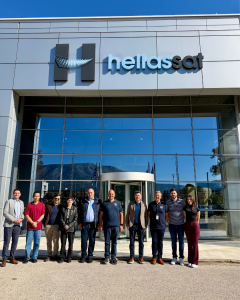
Hellas Sat hosts the 2nd Plenary Meeting of the Horizon Europe project INTOPTEO
Athens, 21 October 2026
Hellas Sat hosted the second plenary meeting of the INTOPTEO project – INTegrated OPToelectronic Oscillators for Earth Observation and Satellite Communications at its premises in Athens.
The meeting brought together the project consortium: UBITECH (Greece, coordinator), the University of Cyprus (Cyprus), Fraunhofer Heinrich Hertz Institute (HHI, Germany), Viper RF (UK) and Hellas Sat.
The partners reviewed progress during the first months of the project, discussed ongoing technical activities and agreed on the next steps.
About the Horizon Europe INTOPTEO Project
Stable, low-noise frequency sources are essential components of satellite communications and Earth observation systems. As these systems operate at higher frequencies and support increasingly demanding applications, maintaining high signal quality presents a significant technical challenge. At the same time, equipment must remain compact and energy-efficient.
The INTOPTEO project aims to address this challenge by developing a tunable integrated optoelectronic oscillator operating in the 40–60 GHz range.
The project combines photonic and radio frequency technologies in a compact system. Its goal is to achieve high frequency stability, low phase noise and reduced size, weight and power consumption.
The proposed approach brings together components developed across four material platforms: gallium arsenide, indium phosphide, thin-film lithium niobate and silicon nitride.
The consortium is also exploring artificial intelligence (AI) techniques to support frequency tuning and long-term stability.
INTOPTEO is a 36-month research project funded by the European Union under Horizon Europe. By the end of the project, the consortium aims to demonstrate and validate the technology at laboratory level, reaching Technology Readiness Level 4 (TRL 4).
INTOPTEO Project: Highlights of the 2nd Plenary Meeting
During the meeting, the consortium:
- Reviewed the preliminary system architecture and the system and component requirements for satellite communications and Earth observation applications. These will be finalised in the project’s first system design report.
- Discussed progress on the photonic chips developed by Fraunhofer HHI and the design of high-frequency amplifiers by Viper RF.
- Agreed on the approach for building and integrating the first prototype modules. Each building block will be tested separately before full integration to reduce technical risk.
- Explored AI-based techniques that could support frequency tuning and long-term stability.
- Planned communication, dissemination, standardisation and exploitation activities for the coming months.
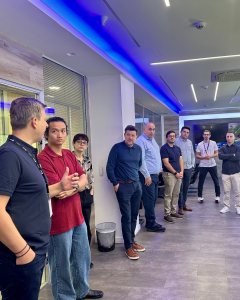
Hellas Sat’s Role in the INTOPTEO Project
As the satellite operator and end user within the consortium, Hellas Sat defines the satellite communications and Earth observation use cases and requirements. The company also leads system-level simulations of the demonstrators.
During the second half of the project, Hellas Sat will lead the demonstration activities.
The INTOPTEO prototype will serve as the local oscillator in representative Q/V-band satellite communications and Earth observation ground-segment testbeds at Hellas Sat’s facilities.
The team will evaluate the prototype alongside conventional oscillators under realistic operating conditions.
The results will inform Hellas Sat’s perspective on future satellite payloads, ground infrastructure and 5G/6G non-terrestrial networks.
For more information about the project, visit the official INTOPTEO website.