
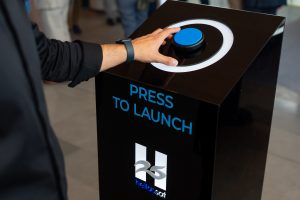
3rd Space Symposium Day 2: Security, European Autonomy and the Next Generation in Space
The second day of Hellas Sat’s 3rd Space Symposium brought European strategy for secure satellite communications, strategic autonomy, emerging defence requirements, the resilience of critical infrastructure and innovation to the forefront of discussions.
The day opened with a welcome address by Christodoulos Protopapas, President & CEO of Hellas Sat. This was followed by addresses from Nicodemos Damianou, Deputy Minister of Research, Innovation and Digital Policy of the Republic of Cyprus, and Dr Emmanuel Rammos, President of the Hellenic Space Center (ELKED), before Martin Van Schaik, IRIS² Deployment & Partnerships, ESA/European Commission, presented the European perspective.
Martin Van Schaik highlighted Europe’s evolving security and defence requirements and the need to ensure that critical communications do not depend on third parties with different strategic interests. He referred to the role of GOVSATCOM and IRIS² as key elements of Europe’s efforts to strengthen autonomy, resilience and secure connectivity.
The opening session concluded with a recorded video address by Aarti Holla-Maini, Director of the United Nations Office for Outer Space Affairs (UNOOSA), who emphasised the importance of ensuring that space development and emerging technologies serve people and the common good.
From Earth to Space: A Conversation with ESA Astronaut Adrianos Golemis
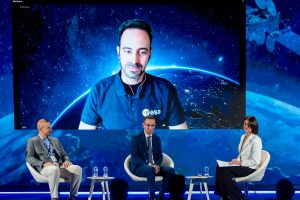
One of the most distinctive moments of the second day was a discussion focusing on the people behind space missions: those preparing to travel into space and those responsible for their training.
The discussion featured Adrianos Golemis, ESA Astronaut, and Eleftherios Karagiannis, Astronaut Instructor and member of the Crew Operations Support team at the European Astronaut Centre, moderated by journalist Christina Vidou.
Joining remotely, Adrianos Golemis discussed his preparations for a future mission to the International Space Station (ISS), with the earliest possible launch window, as he explained, expected in summer 2027.
His training has already begun and is becoming increasingly specialised as the mission approaches. He explained that no individual, regardless of their selection process or previous experience, can be considered completely prepared for an environment as extreme as space. Training is designed to enable astronauts to perform at the highest possible level within a limited timeframe and under conditions that cannot be fully replicated on Earth.
Preparation covers an exceptionally broad range of scenarios, from responding to emergencies such as a fire aboard the International Space Station to conducting scientific experiments with precision and working effectively within a multinational crew.
Golemis also emphasised the extensive team supporting every astronaut. His previous experience in astronaut medical support has given him a particular appreciation of the work involved in every operational decision and schedule adjustment.
He referred to recent training in the United States, which included preparation for the spacecraft capsule as well as practical aspects of living in space. Among these was the selection of food for the mission, with astronauts sampling approximately 200 different food items in small quantities to determine which were most suitable for each individual.
Golemis noted that the prospect of the next European presence aboard the International Space Station having a Greek connection was a source of particular pride and another important step for Greece’s participation in the European space programme.
Eleftherios Karagiannis described the practical demands of astronaut training, explaining that substantial preparation begins at least one year before a mission. It involves both scientific and technical training and the development of a crew capable of functioning as a cohesive team.
He compared astronauts to Formula 1 drivers: while one individual must perform at the highest level, a large team of instructors, engineers, scientists and support personnel works behind the scenes to prepare every detail.
Golemis’s anticipated mission is expected to last approximately two weeks, making preparation particularly demanding. During such a short mission, the human body has limited time to adapt to weightlessness, and the astronaut must reach peak performance as quickly as possible.
Karagiannis also discussed astronaut selection, explaining that candidates are assessed not on a single qualification but on a combination of knowledge, medical suitability, psychological resilience, physical fitness, skills, adaptability and the ability to absorb large amounts of information in a short period.
Being a pilot is not an absolute requirement, he explained, although aviation experience may demonstrate an ability to operate complex systems, process multiple streams of information and make decisions under demanding conditions.
Behind the training process is a specialised team of approximately 16 instructors, each responsible for a particular field and required to develop extensive expertise before training astronauts. The objective is not for astronauts to master every technical detail, but to acquire precisely the knowledge needed to complete their missions safely and effectively, with continuous support from ground teams.
The Next Generation Takes the Floor: Artemis Peggy Koukoura
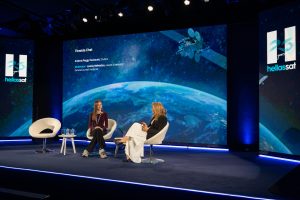
Another particularly engaging moment was an unexpected conversation with student Artemis Peggy Koukoura, moderated by Loukia Vafeiadou, General Counsel of Hellas Sat.
As Loukia Vafeiadou explained, they first met a few months earlier at the Space Tech Forum, when the young student independently approached professionals in the sector to learn more about astrophysics, aerospace, academic studies and the opportunities available to young people interested in pursuing a career in space.
Artemis explained that her motivation came from her passion for astrophysics and aerospace and her desire to speak with professionals already working in the field, explore educational programmes and potential academic pathways, and expand her knowledge.
Reflecting on the discussions at the 3rd Space Symposium, she highlighted the growth of the Greek space ecosystem and the increasing number of career opportunities emerging for young people within Greece.
The possibility of pursuing a career in space without automatically having to move abroad, she noted, gives her considerable hope for the future.
Discussing her own vision of space development, she emphasised logic, critical thinking and responsibility, connecting these principles with sustainable development, risk management and challenges such as space debris.
Her message to today’s decision-makers was equally clear: they must act responsibly towards the younger generation, whose scientists will build upon the foundations being established today.
Speaking on behalf of her generation, she encouraged her peers to pursue their dreams and ambitions and never give up.
3rd Space Symposium – Panel I: Regulatory Framework, Governance and Ethics in the “New Space” Era
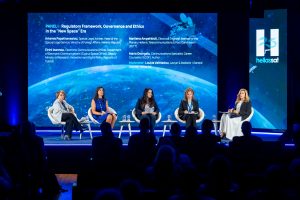
The first panel examined a question extending beyond the strictly legal dimension of space activities: who will establish the rules in a space environment evolving much faster than international law?
The discussion featured Artemis Papathanasiou, Special Legal Adviser and Head of the Special Legal Service at the Ministry of Foreign Affairs of the Hellenic Republic; Eirini Ioannou, Electronic Communications Officer at the Department of Electronic Communications (Cyprus Space Office), Deputy Ministry of Research, Innovation and Digital Policy of the Republic of Cyprus; Marilena Ampelikoti, Electrical Engineer and Member of the Plenary of the Hellenic Telecommunications & Post Commission (EETT); and Maria Georgala, Communications Specialist, Career Counsellor (GCDF) and Author.
The panel was moderated by Loukia Vafeiadou, Lawyer & Mediator and General Counsel of Hellas Sat.
Loukia Vafeiadou highlighted the significance of an all-female panel in a sector where the presence of young women scientists and legal professionals continues to grow.
Looking back at Hellas Sat’s early years, she recalled that the company had to safeguard a critical sovereign right within an international regulatory framework that did not provide clear answers to many emerging challenges.
She explained that major changes to international space law are particularly difficult because they require broad agreement among states. As technology advances much faster than legislation, the international community increasingly relies on non-binding rules, guidelines and forms of soft law to address emerging regulatory gaps.
Artemis Papathanasiou referred to the five principal United Nations treaties governing outer space, beginning with the Outer Space Treaty, and the fundamental principles on which international space law was established: that the exploration and use of outer space should be free and conducted for the benefit of all countries and humanity as a whole.
She highlighted the growing involvement of the private sector on a scale that the original treaties could not have anticipated. A legal framework developed when states were the principal actors must now address a reality in which private companies have an increasingly significant presence and capabilities.
This transformation has created substantial regulatory gaps, while many states remain reluctant to adopt new binding rules and instead favour more flexible mechanisms.
She reaffirmed Greece’s commitment to the United Nations framework and the principle of the peaceful use of outer space.
Eirini Ioannou emphasised the need for technological development to be accompanied by clear rules, accountability and security. As more activities move into space, coordination at European and international level becomes increasingly important.
The challenge, she explained, is to strike the right balance: enabling innovation and growth while safeguarding the public interest, security and the sustainability of the space environment.
Marilena Ampelikoti focused on orbital positions and radio spectrum. She explained that, in practice, priority is closely linked to who submits the relevant technical filing first, giving an advantage to those with the resources and expertise to act more quickly.
A system established decades ago was not designed for today’s reality of thousands of satellites and large constellations. The challenge is therefore no longer purely technical. It concerns the sustainable use of spectrum and orbital resources, equitable access for all countries and the protection of rights secured through significant effort.
Maria Georgala explored the social and ethical dimensions of space activities, questioning what is meant by the “benefit of humanity”.
Humanity, she observed, is not a uniform community without inequalities, differing capabilities or competing interests. She questioned whether the exploitation of space resources and further space development risk reproducing models of inequality already familiar on Earth.
Genuine progress, she argued, cannot be measured solely by what technology makes possible. It must also reflect equality, participation, accountability and social responsibility.
She concluded by raising a fundamental question: do we have the right to determine the future of people and generations who do not yet have a voice in today’s decision-making processes?
Panel II: Space & Defence – Communications, Autonomy & Operational Readiness
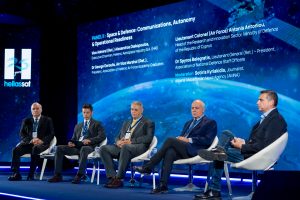
The second panel shifted the discussion from the regulatory environment to operational realities.
Participants included Vice Admiral (Ret.) Alexandros Diakopoulos, Executive Chairman of Hellenic Aerospace Industry S.A. (HAI); Dr George Geroulis, Air Vice Marshal (Ret.) and President of the Association of Hellenic Air Force Academy Graduates (SASI); Lieutenant Colonel (Air Force) Antonis Antoniou, Head of the Research and Innovation Sector at the Ministry of Defence of the Republic of Cyprus; and Dr Spyros Belegratis, Lieutenant General (Ret.) and President of the Association of National Defence Staff Officers (SEETHA).
The discussion was moderated by Sotiris Kyriakidis, journalist at the Athens-Macedonian News Agency (AMNA).
Drawing on lessons from the Russia–Ukraine war and more recent conflicts, Sotiris Kyriakidis asked participants to identify the most critical dependence of the Armed Forces on space capabilities in the event of a major crisis.
Alexandros Diakopoulos stressed that space is no longer separate from military operations but increasingly contributes to every form of modern warfare.
In an environment characterised by intense electronic warfare, new sensors and technologies that make the operational landscape increasingly transparent, secure communications and effective use of the electromagnetic spectrum have become essential.
Recalling his service aboard frigates during the Gulf War in the early 1990s, he noted that advanced communications capabilities were sometimes regarded as a luxury. Today, they are indispensable: without reliable communications, even the most advanced weapons systems may lose a substantial part of their operational value.
George Geroulis referred to the longstanding relationship between the Hellenic Air Force and aerospace technology, stressing the need to approach space as part of an integrated operational system connecting ground, air and space infrastructure.
He highlighted the importance of secure communication between ground infrastructure and satellites, as well as the development of national capabilities capable of supporting the country during crises.
Recent developments in Ukraine and the Middle East, he noted, have demonstrated that such capabilities cannot be taken for granted or treated solely as technological matters.
Antonis Antoniou observed that recent conflicts have clearly demonstrated the significance of space capabilities, from telecommunications and satellite imagery to the provision of precision data on the battlefield.
The integration of information with operational assets is now critical. However, an equally important question arises when a state does not control the capabilities on which it depends and must rely on external providers.
For defence applications, he emphasised, the key considerations are security, availability, accessibility and trust in the service provider.
Spyros Belegratis discussed operational lessons from Ukraine and the Middle East, noting that the use of space capabilities has become an integral part of military planning.
He recalled that, from the beginning of operations in Ukraine, both the vulnerability of critical communications infrastructure and the decisive role that private space companies can play when government systems experience disruption became apparent.
Developments in the Middle East have similarly highlighted the importance of space systems for accurate terrain imagery, target identification and the support of precision operations.
These lessons, he argued, should inform Greek defence planning through a model of systematic cooperation among the Armed Forces, government authorities, universities, research institutions and private companies in developing technology and innovation.
Panel III: Digital Resilience & Critical Communications Infrastructure
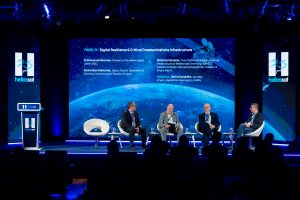
The third panel focused on the need to maintain secure and reliable communications even when terrestrial infrastructure is placed under severe pressure or becomes unavailable.
Participants included Dr Emmanuel Rammos, President of the Hellenic Space Center (ELKED); Andronikos Kakkouras, Deputy Director of the Department of Electronic Communications of the Republic of Cyprus; and Dimitrios Katsianis, Vice-Chairman of the Board of National Infrastructures for Research and Technology (GRNET) and Assistant Professor at the National and Kapodistrian University of Athens (NKUA).
The discussion was moderated by Sotiris Kyriakidis of the Athens-Macedonian News Agency (AMNA).
Emmanuel Rammos highlighted the rapid evolution of communications technologies and the close interaction between technology and market demand.
Today, citizens, businesses and public authorities expect connectivity everywhere, at all times and with appropriate security.
Despite major technological advances, from mobile networks to geostationary satellites and low Earth orbit constellations, connectivity cannot yet be guaranteed in every location and under all conditions.
A significant part of the challenge, he explained, is financial: the more difficult an area is to reach, the greater the investment required to establish the necessary infrastructure.
Moreover, providing a connection is not enough. Connectivity must be reliable, high-quality and available even under exceptional demand. During a major earthquake, for example, thousands of people attempting to use mobile networks simultaneously may cause congestion.
In such circumstances, satellite communications play a decisive complementary role when terrestrial networks cannot meet demand.
As he summarised, the challenge is not the absence of technology, but the financing required to deploy technologies that can provide connectivity in difficult-to-reach areas.
Andronikos Kakkouras shared Cyprus’s experience, recalling the challenges faced during Hellas Sat’s early years, when major European satellite operators remained sceptical about Greece and Cyprus establishing a substantial presence in the sector.
Today, Cyprus has highly developed terrestrial infrastructure under normal conditions, including fibre-optic networks and extensive 5G coverage. The critical challenge emerges when circumstances are no longer normal.
During natural disasters, geopolitical crises or major security incidents, alternative communications routes and rapid restoration capabilities are essential.
Satellite coverage, he stressed, should not be treated as a solution sought only after a crisis begins. It must be integrated into contingency planning in advance so that it is immediately available when required.
He cited the use of satellite services along Cyprus’s Green Line as an example of circumstances in which alternative communications infrastructure is particularly important.
Kakkouras also pointed to a much broader technological transformation. New satellite constellations, direct-to-user services and the ability to connect devices directly to satellite networks are fundamentally changing the connectivity landscape.
He referred to new high-capacity technologies capable of delivering performance approaching that of terrestrial networks, describing this development as a game changer.
However, he also noted that today’s achievements have been built on earlier setbacks. Systems such as Iridium and Teledesic attempted to introduce satellite connectivity models decades before many of their underlying concepts became commercially viable.
The major difference today lies in the transformation of technological capabilities and launch costs, making systems feasible that could not have been economically sustainable two or three decades ago.
Dimitrios Katsianis focused on another major challenge: the security of information itself, with particular emphasis on optical and quantum communications.
He discussed the significant investments made in Greece to develop very high-speed networks and connect critical research infrastructure, noting that available data transmission speeds have increased dramatically and could rise further in the coming years.
He also presented the development of Greece’s quantum communications infrastructure and its integration into a wider European environment, including terrestrial and satellite connections and cooperation with countries such as Cyprus, the Netherlands and Bulgaria.
The importance of these technologies lies not only in speed, but also in the ability to provide substantially stronger assurances that information reaches its intended recipient and that the received signal is authentic.
He highlighted the transition from laboratory research to operational infrastructure and real-time testing, stressing that quantum technologies are increasingly being considered for protecting governmental, defence, research and other sensitive communications.
Panel IV: Research and Innovation in the Space Industry
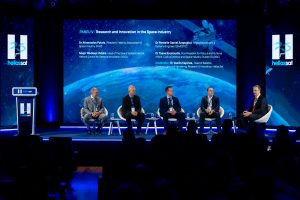
The fourth panel of the 3rd Space Symposium explored how research and technological development can be transformed into products, services and applications with tangible operational and commercial value.
Participants included Dr Athanasios Potsis, President of the Hellenic Association of Space Industry (HASI); Major Nikolaos Vidalis, Head of the Space Systems Sector at the Hellenic Centre for Defence Innovation (ELKAK); Dr Pantelis-Daniel Arapoglou, Telecommunications Systems Engineer at ESA/ESTEC; and Dr Tasos Kounoudis, Vice President for Policy and Institutional Affairs at the Cyprus Defence and Space Industry Cluster (CyDSIC).
The discussion was moderated by Dr Vasilis Kapinas, Head of Satellite Communications Engineering, Research & Innovation at Hellas Sat.
Vasilis Kapinas opened the discussion by asking what the most important prerequisite is for research and innovation in the space sector to result in products and services that can be used in practice.
As he explained, innovation goes one step beyond research, requiring practical application, implementation and measurable results.
Athanasios Potsis described Hellas Sat’s 25th anniversary as an important milestone, recognising the company’s role as one of the key contributors to the development of Greek space activity.
He focused on what he considers a continuing challenge for Greece: transforming research and technological expertise into competitive products and services capable of creating markets and supporting the international expansion of Greek companies.
He identified Greece’s participation in the European Space Agency (ESA) as a decisive catalyst. Membership encouraged Greek industry to operate competitively from the outset, pursue contracts and develop products and services used within European space programmes.
He also highlighted the role of the ESA Business Incubation Centre (ESA BIC), which enables young scientists and startups to evaluate, finance and develop space-related business ideas.
At the same time, he identified the need for a more systematic national strategy for participation in major European space programmes.
Referring to the initial phase of Galileo, in which, as he noted, Greek industrial participation was absent, he observed: “We had the technology, but we did not have the lobbying capacity.”
He stressed that the next step is to organise national efforts more effectively. Greece, he noted, is now firmly on the space map, representing a national achievement on which the next phase must be built.
Nikolaos Vidalis focused on connecting research and innovation with actual operational requirements.
For a product to be genuinely useful, he explained, it must first address the needs of the end user. This requires direct cooperation among operational users, industry and the research community.
He illustrated this through a recent exercise involving different operational assets and environments, during which difficulties emerged in establishing a common operational picture.
Hellas Sat, which participated in the exercise, identified the problem on site, worked with the relevant organisations and contributed directly to creating a unified picture accessible at different levels of command.
This example, he explained, demonstrates applied innovation: industry identifies a real need, develops a solution, tests it in the field and subsequently invests time, resources and research in improving it.
He also stressed the importance of identifying the actual end user, noting that a ministry or central authority should not automatically be considered the end user when the real operational requirement exists in the field.
Programmes such as the European Defence Fund (EDF), NATO’s DIANA initiative and the activities of ELKAK seek to bridge this gap through exercises, challenges and cooperation with operational organisations, helping develop products that are not only innovative but also useful, mature and competitive.
Pantelis-Daniel Arapoglou explained how the European Space Agency structures innovation funding to ensure that research progresses beyond the laboratory and ultimately becomes a product.
A central tool is the Technology Readiness Level (TRL) scale, which measures the maturity of a technology and its proximity to operational application.
ESA, he explained, supports different stages of technological maturity with the objective of helping technologies progress towards practical products and services rather than financing research solely for its own sake.
He also discussed the convergence of terrestrial and satellite communications through non-terrestrial networks within the 5G ecosystem, as well as the growing importance of in-orbit demonstrations and validations.
Europe, he noted, is increasingly adopting faster approaches to testing technologies under real conditions, accepting greater technological risk to accelerate innovation and reduce the time required to move from an idea to a market-ready product.
Tasos Kounoudis shared Cyprus’s experience, highlighting how progress in recent years has been driven by persistence, cooperation among companies and close engagement with the Ministry of Defence and the Deputy Ministry of Research, Innovation and Digital Policy.
Cyprus, he explained, has reached a stage where the challenge is no longer limited to developing technology. The priority is now scaling up: moving from prototypes and research results to commercial production, including manufacturing infrastructure, assembly lines and export capabilities.
He emphasised that Cyprus’s progress was not sudden but the result of many years of work by companies and professionals in the sector.
He also stressed the importance of direct engagement between businesses and operational users, ensuring that technological development begins with genuine requirements rather than theoretical assumptions.
“We must move beyond simply creating technologies and start creating applications,” he noted, explaining that meaningful success emerges when operational needs, research, industry, government support, production and international engagement are effectively connected.
Panel V: Crisis Management – The Role of Satellite Services
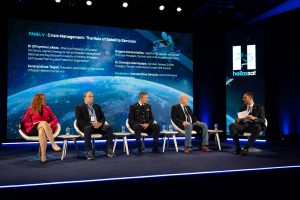
The fifth and final panel moved from planning to practical implementation, examining what happens when a crisis occurs and infrastructure, communications and information must operate immediately, reliably and in coordination.
Participants included Dr Efthymios Lekkas, Emeritus Professor of Dynamic Tectonics, Applied Geology & Natural Disaster Management at the National and Kapodistrian University of Athens and President of the Earthquake Planning and Protection Organization (OASP); Konstantinos Tsigas, President of the Association of Fire Service Officers (EAPS); Grigoris Konstantellos, Mayor of Vari, Voula & Vouliagmeni and First Vice-President of the Central Union of Municipalities of Greece (KEDE); and Dr Christina Giannopapa, Secretary General of EURISY and President of Women in Aerospace Europe (WIA-Europe).
The discussion was moderated by Konstantinos Geroulis, Chief Commercial Officer of Hellas Sat.
Konstantinos Geroulis opened the discussion with a central question: in a real crisis, what is ultimately more critical — information or communication?
An earthquake, flood or other major emergency cannot always be prevented, he noted. The objective is to reduce vulnerability and strengthen the system’s ability to respond.
Efthymios Lekkas drew on different crisis situations to demonstrate that there is no single answer applicable to every case.
Referring to Santorini, he explained that the challenge was not a lack of data but the opposite: an enormous volume of information that had to be processed and evaluated rapidly to reach reliable conclusions about the evolution of the phenomenon.
In other missions, including Venezuela and Nepal, the difficulties involved accessing information and maintaining communications, whether because of restrictions, damaged infrastructure or challenging geography.
His contribution highlighted that the critical gap may concern information, communication or the ability to process available data in time. This is precisely why multiple resilient layers of communication are necessary.
Konstantinos Tsigas focused on the two-way relationship between personnel in the field and the Operations Centre.
The centre must receive reliable information from the location of an incident while simultaneously transmitting the appropriate instructions and information to operational teams, enabling resources to be directed where they are most needed.
Managing a fire, building collapse or major natural disaster requires accurate and up-to-date data, as well as close cooperation between operational organisations and technology providers.
Technology companies, he emphasised, must understand the real needs of personnel working in the field so that the systems they develop perform effectively under actual operational conditions.
He also highlighted the importance of prevention, explaining that disaster management encompasses prevention, preparedness, response and recovery.
Prevention, he stressed, means knowledge, information, education and the development of a culture of preparedness from an early age, strengthening societal resilience and reducing vulnerability.
Grigoris Konstantellos placed particular emphasis on communications.
“When you have no communication, you are on your own,” he observed, noting that a temporary lack of information can sometimes be addressed through an assessment, whereas the complete absence of communication cannot.
Drawing on his personal experience in civil aviation, he explained how even a carefully designed system can become disorganised when its individual components are unable to communicate with one another.
For this reason, every operational plan must include redundancy: if the primary system fails, an alternative must be available.
He also identified three essential qualities of information during a crisis: it must be accurate, timely and concise.
Otherwise, an excessive volume of data can become noise rather than support for those responsible for making decisions.
He referred to the Municipality of Vari, Voula and Vouliagmeni’s investments in technology, human resources and planning to ensure operational continuity even when terrestrial infrastructure suffers significant damage.
Christina Giannopapa emphasised that space services become particularly important under precisely these circumstances.
When terrestrial communications are disrupted, satellite infrastructure can provide a critical alternative layer.
She referred to GOVSATCOM, Copernicus and Galileo, highlighting Europe’s gradual development of a more interconnected and resilient environment for critical communications.
However, she stressed that the challenge is not purely technological. Appropriate skills are also essential so that future generations of civil protection professionals, firefighters and crisis management personnel understand what space services can provide and how to use them effectively.
Across Europe, she noted, crisis management structures remain highly diverse, and information does not always reach the appropriate organisation at the right time.
Workshops, joint exercises and continuous dialogue among service providers, governments and operational users are therefore particularly important, especially when crises extend beyond national borders.
The panel also highlighted the importance of field exercises in identifying weaknesses that may not be apparent during theoretical planning.
A notable example was the “Minos” exercise in Crete, where the geography of the Samaria Gorge demonstrated the need for small, portable satellite terminals that rescuers could carry into locations inaccessible to vehicles or conventional infrastructure.
The shared conclusion was that genuine resilience requires reliable information, continuous communications, backup systems, interoperability and people who understand how to use the available technologies.
Satellite services are no longer simply supplementary tools. They have become an essential component of planning for prevention, preparedness and effective crisis management.
Investing in the Next Generation: Hellas Sat Student Projects and Scholarships
The second day of the 3rd Space Symposium also placed particular emphasis on the next generation of scientists, highlighting Hellas Sat’s links with universities and its continued support for young people pursuing careers in the space sector.
Andreas Dimitrakakis, a student at the Department of Aerospace Science and Technology of the National and Kapodistrian University of Athens and responsible for Hellas Sat’s satellite remote sensing activities, presented the work of the company’s student remote sensing team.
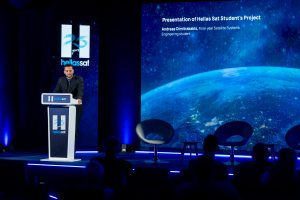
The team consists of young students and Hellas Sat scholarship recipients and develops applications across two main areas: Earth observation and research, and strengthening the security and resilience of Greece and Cyprus.
Using satellite data, including information from Sentinel-3 and Sentinel-5P, the students are developing applications addressing marine heatwaves, atmospheric humidity, ozone, drought and soil moisture.
They are also working on applications directly relevant to civil protection and critical infrastructure, including oil spill detection, monitoring vessels near coastlines, studying ground displacement and mapping burned areas.
These activities aim, among other objectives, to support improved assessment of wildfire, flood and landslide risks.
Concluding his presentation, Andreas Dimitrakakis thanked Hellas Sat for the trust and freedom it gives young scientists to experiment, explore new ideas and pursue activities beyond the traditional scope of satellite telecommunications.
The company’s investment in the next generation was also reflected in the award of Hellas Sat scholarships to students of the Department of Aerospace Science and Technology at the National and Kapodistrian University of Athens.
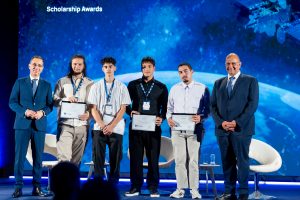
The scholarships were presented by Nicodemos Damianou, Deputy Minister of Research, Innovation and Digital Policy of the Republic of Cyprus, to Georgios Alexakis, Christos Kardakos, Alkiviadis Emmanouil Varvitsiotis and Nikos Xenofontos.
The ceremony reflected one of Hellas Sat’s longstanding commitments: maintaining strong connections with universities, supporting student-led projects and creating opportunities for young people to transform the knowledge and talent available in Greece and Cyprus into meaningful scientific and professional careers in the space sector.
The awards ceremony continued with recognition of students from the Hellenic Air Force Academy.
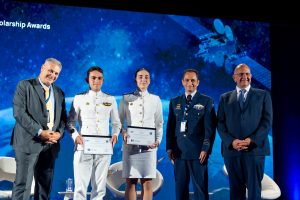
George Geroulis, Air Vice Marshal (Ret.) and President of the Association of Hellenic Air Force Academy Graduates, presented awards to third-year Flight Cadet Sokratis Laiakis and third-year Air Defence Controller Cadet Maria Fotiadou.
Closing the 3rd Space Symposium: Passing the Baton to the Next Generation
Closing the 3rd Space Symposium, Christodoulos Protopapas, President & CEO of Hellas Sat, connected the two days of the event through a journey from the past to the future.
He explained that the first day had been dedicated to Hellas Sat’s 25-year history and a journey that began in the early 1990s.
The second day focused on the present: the changes taking place in Europe and internationally, satellite communications, defence, security and crisis management.
The final part of the event, however, was dedicated to the future and the next generation.
“We are passing the baton,” was Christodoulos Protopapas’s message, referring to Adrianos Golemis, Andreas Dimitrakakis, the young students and scientists who participated in the event, and Artemis Peggy Koukoura as examples of the generation that will carry the Greek space ecosystem forward.
He thanked the Hellas Sat team and everyone involved in organising the event, which he described as significantly enhanced, acknowledging the partners who contributed to its preparation and delivery.
He also thanked Nicodemos Damianou, Deputy Minister of Research, Innovation and Digital Policy of the Republic of Cyprus, for attending, along with all speakers, participants and partners involved in the two-day event.
He renewed the invitation for Hellas Sat’s 4th Space Symposium, scheduled to take place the following October as part of World Space Week.
Concluding, Christodoulos Protopapas returned to the message that had run throughout the two-day event: Hellas Sat views space activity not only as technology and infrastructure, but also as a community of people and a continuity between generations.
In this context, he referred to the company’s intention to expand its support for young people through scholarships and internship opportunities, including potential cooperation with the Hellenic Air Force Academy.
For further information about the event, visit the official 3rd Space Symposium programme.
Original Press Release (Greek): Download the Greek Press Release