
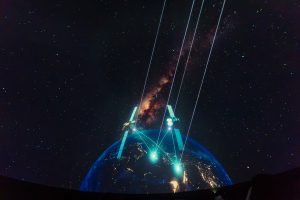
Hellas Sat Celebrates 25 Years in Space and Looks Ahead to HELLAS SAT 5
The 3rd Space Symposium opened with an anniversary evening celebrating 25 years of Hellas Sat’s presence and growth. The event highlighted the journey that placed Greece and Cyprus on the European and international space map, as well as the new era emerging for critical space infrastructure, secure communications and strategic autonomy.
The evening was presented by journalist Christina Vidou, who guided the audience through an event dedicated to Hellas Sat’s history, people and future.

A highlight of the anniversary celebration was the screening of a video tracing the company’s journey, from its early beginnings and the securing of the 39° East orbital position to the development of its satellite and ground infrastructure and its next major step, HELLAS SAT 5.
Christodoulos Protopapas: 25 Years of an Idea That Became Space Infrastructure
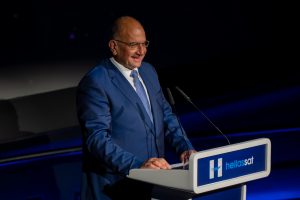
Christodoulos Protopapas, President & CEO of Hellas Sat, opened the evening by reflecting on a journey that began in the 1990s, when Greece and Cyprus started securing and jointly exercising their rights at the 39° East orbital position.
As he recalled, in 2001, Hellas Sat undertook, through the Concession Agreement, to transform this opportunity into actual space infrastructure within a strict timeframe that required investment, expertise and considerable business risk.
The launch of HELLAS SAT 2 in 2003 marked the first major milestone. HELLAS SAT 3 followed in 2017 and HELLAS SAT 4 in 2019, expanding the company’s coverage across Europe, the Middle East and Africa. Today, Hellas Sat operates space control centres, ground infrastructure, large antenna systems and data centres in Greece and Cyprus, while participating in European space and defence programmes and supporting secure governmental communications.
Christodoulos Protopapas emphasised that this journey was supported by the company’s own private investment and entrepreneurial risk, without placing a burden on state budgets. Hellas Sat has developed into a financially sound and profitable European enterprise, with people and infrastructure in Greece and Cyprus.
He also referred to the current geopolitical environment, noting the growing strategic importance of critical technological and space infrastructure. As he stressed, strategic autonomy concerns not only defence but also sovereignty over technology and communications, resilience and confidence in a country’s own technological capabilities.
In this context, he highlighted Hellas Sat’s participation in the European GOVSATCOM programme as Greece’s direct partner, pointing to the increasing role of satellite infrastructure in secure governmental communications and Europe’s strategic autonomy.
Looking ahead, the company is already planning its next chapter. The new HELLAS SAT 5 satellite is in the planning stage, with the aim of further enhancing the value of the 39° East orbital position for Greece, Cyprus and Europe over the next 25 years.
Concluding his remarks, Christodoulos Protopapas paid particular tribute to the people who have contributed to Hellas Sat’s journey over the years, as well as those who envisioned Greece’s and Cyprus’s presence in space long before it became a reality.
“A country’s presence in space is not the work of a single generation,” he noted, emphasising that each generation inherits a legacy of knowledge, institutions and trust, and has a responsibility to pass it on stronger to the next.
Dimitris Papastergiou: “The Sky Is Not the Limit. It Is the Beginning.”
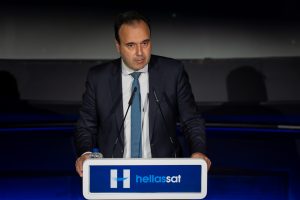
Dimitris Papastergiou, Minister of Digital Governance & Artificial Intelligence of the Hellenic Republic, highlighted the strong interest of Prime Minister Kyriakos Mitsotakis and the Greek Government in developing the country’s space sector, noting that developments in recent years have created a new reality for Greece.
As he explained, 25 years ago, space was far removed from public debate and the country’s priorities. Nevertheless, there were people who had already recognised its importance and the need for Greece to maintain and strengthen its presence in this field.
“Today, the picture is different. Greece is developing its own microsatellite programme, Hellas Sat is preparing HELLAS SAT 5, and Greek companies, research teams and scientists are establishing an increasingly strong presence in the space sector,” he noted.
He placed particular emphasis on young scientists returning to Greece to work for advanced technology companies, describing this development as an important foundation for the future.
Dimitris Papastergiou also highlighted the importance of space for security and communications, noting that the presence of Armed Forces representatives at the event demonstrated just how critical the sector has become.
He also referred to the technological capabilities already being developed in Greece, ranging from satellite communications to optical links between satellite and ground infrastructure.
“Miracles are happening in this country,” he stressed, adding: “The sky is not the limit. It is the beginning.”
Concluding, he focused on the practical value of satellite services in real crisis situations, citing Santorini as an example, where, as he put it, when the need arose, “with just one phone call, Hellas Sat was there.”
Dr Panayiotis Chatzipavlis: Space as a Cross-Cutting Enabler of Power
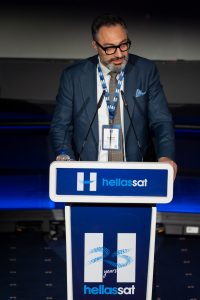
Dr Panayiotis Chatzipavlis, Director of the Directorate of Armaments and Defence Capabilities Development at the Ministry of Defence of the Republic of Cyprus, conveyed the greetings and congratulations of the Minister of Defence to Hellas Sat’s management and staff.
He emphasised that the anniversary was not only an opportunity to reflect on past achievements but, above all, an occasion to look towards the future, at a time when space has become central to security, defence and the functioning of modern states.
“Space technology is not simply another tool. It is a cross-cutting enabler of power,” he stressed, referring to its importance for the technological and industrial base, international presence, secure communications and effective crisis management.
He also highlighted the strategic cooperation between Greece and Cyprus, noting that it could be further strengthened through a shared operational approach, technological research and the development of secure and resilient communications.
“Our ambition cannot be limited to using technology developed elsewhere,” he stated, emphasising the need for Greece and Cyprus to further strengthen their own presence in the space sector.
Stavros Avgoustides: “I Thought the First Greek Astronaut Was Christodoulos Protopapas”
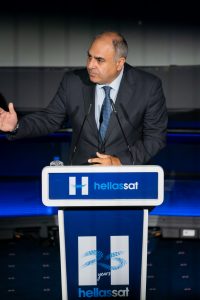
Stavros Avgoustides, Ambassador of the Republic of Cyprus to the Hellenic Republic, who represented the President of the Republic of Cyprus, adopted a more personal tone, opening his remarks with a humorous observation: “I was under the impression that the first Greek astronaut was Christodoulos Protopapas.”
Referring to his longstanding acquaintance with the President & CEO of Hellas Sat, he noted that this year’s event held particular significance for the Republic of Cyprus, as it had been included in the “Days of Cyprus”, a multifaceted initiative organised over the past three years by the Embassy of Cyprus in Athens to showcase a modern and outward-looking Cyprus.
As he noted, “space could not be absent” from this initiative. Once a sector largely outside public debate, it has become one of the most dynamic areas of development and cooperation.
He also referred to the younger generation, highlighting the importance of the scholarships to be awarded again this year as an investment in the young people who will carry forward the presence of Greece and Cyprus in the space sector.
Concluding, he congratulated Hellas Sat on behalf of the President of the Republic of Cyprus for its 25-year journey, noting that the President himself had visited the company’s facilities and witnessed first-hand the dedication, expertise and capabilities of its personnel.
Konstantinos Karantzalos: “We Have a Strategy. We Know Where We Want to Go.”
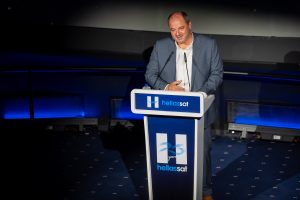
Konstantinos Karantzalos, Secretary General for Telecommunications and Postal Services at the Ministry of Digital Governance of the Hellenic Republic, focused on the future and the transition from individual initiatives to more systematic national planning for the development of the space sector.
He noted that investment in new technologies, capability development and human capital has increased in recent years, enabling scientists and engineers who previously sought opportunities abroad to remain in or return to Greece and work on advanced technologies.
“We are not pursuing isolated developments. We have a strategy, we know where we want to go, and we are gradually seeking to develop an increasing share of the technology within the country,” he stressed.
Konstantinos Karantzalos also referred to the opportunities for Greek companies to participate in consortia and establish a European and international role, as well as applications involving high-precision data analysis, thermal imagery, radar, satellite observation systems and new communications capabilities.
He placed particular emphasis on the next generation and initiatives being planned for students and young scientists, ranging from educational programmes and small satellites to scientific experiments covering fields from medicine to culture.
“It Looks to the Sky but Keeps Its Feet Firmly on the Ground”
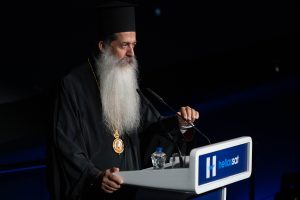
His Eminence Metropolitan Symeon of Fthiotida congratulated Hellas Sat, Christodoulos Protopapas and everyone who had contributed to the company’s journey.
In a concise observation, he noted that Hellas Sat had succeeded because “it looks to the sky but keeps its feet firmly on the ground,” emphasising that a 25th anniversary is, above all, an opportunity to celebrate and recognise a significant journey.
The 3rd Space Symposium: Looking Ahead to Day 2
The 3rd Space Symposium continued on 8 October 2026 with a comprehensive programme of discussions and presentations addressing the most significant challenges of the new space era.
The programme included thematic discussions on Space and Defence, digital resilience and critical communications infrastructure, research and innovation in the space industry, and the contribution of satellite services to crisis management.
The second day also featured fireside discussions with professionals at the forefront of space activities, a presentation of student work at Hellas Sat and a scholarship award ceremony, placing particular emphasis on the next generation and the people who will shape the future of the space sector in Greece and Cyprus.
For further information about the event, visit the official 3rd Space Symposium programme.
Original Press Release (Greek): Download the Greek Press Release